
Procedure is required action to be followed: Procedure is the established way of doing something; a series of actions conducted in a certain order; and/or steps necessary to meet the terms of a grant agreement.
Guidance is supporting information or recommended action: Guidance consists of recommended best practices; helpful context; and/or tools, resources and examples.
Effective Date: 07/01/2026
The executed agreement is the legal document between BWSR and the recipient. Requirements are met by using assurances to document that installed practices, and other activities meet the purposes of the program and provide the expected outcomes.
There are three primary types of assurance:
- Sub-agreements
- Technical Quality Assurance
- Project and Practice Assurances
II. Guidance
Factors such as program requirements, partners, landownership, type of practices, and cost influence what type of and when certain assurances are required or used.
Sub-agreements
I. Procedure
Funds may be distributed to partner(s) through the use of sub-agreements. Activities identified in the sub-agreement must fit within the scope of the agreement between BWSR and the recipient and include requirements for fund distribution, implementation, and reporting.
II. Guidance
Legal counsel assistance is encouraged when developing sub-agreements.
Technical Quality Assurance
I. Procedure
Practices and projects must meet the following requirements to ensure long-term public benefit:
a) Technical Assistance Provider. The recipient must designate technical assistance provider(s) that have appropriate credentials for investigation, design, and construction.
b) Practice Standards. Practices and projects must use appropriate standards for design, construction, effective life, operation, and maintenance.
c) Practice Certification. Technical assistance provider(s) must certify that the practice or project was installed or constructed in accordance with the applicable plans and specifications, including approved modifications, prior to authorization for payment.
d) Operation and Maintenance. Technical Assistance Provider(s) must prepare an operation and maintenance (O&M) plan specific to the site and practice(s) implemented. Prior to installation, prepare the O&M plan and review the plan with the responsible party. O&M plans must:
Detail the O&M activities that are expected for the project;
Specify how and when to accomplish all activities;
Determine the required inspection schedule; and
Specify contact information should questions or issues arise.
e) Periodic Practice/Project Inspection. Inspections shall confirm that the operation and maintenance plan is being followed and the project has not been altered or removed. Routine inspections must:
Be completed by the organization based on the inspection schedule identified in the O&M plan;
Verify that all components of the practice/project remain in place and are in good repair; If not, issues identified must be assessed by Technical Assistance Provider(s) to determine necessary repairs required to maintain effectiveness of the practice/project.
II. Guidance
Technical Assistance Provider credentials can include professional licensure, vendor with applicable expertise and liability coverage, USDA-NRCS Job Approval Authority (JAA), or other applicable credentials, training, and/or experience.
USDA-NRCS Field Office Technical Guide (FOTG) practice standards, MN Stormwater Manual, other applicable standards can be used. If published standards are not applicable to site specific conditions, a designed solution that relies on the professional licensure of the designer may be used.
Operation and maintenance (O&M) plans should be developed and reviewed with the responsible party prior to practice/project installation. An O&M plan can be modified to address changing site conditions or other factors that may impact the effectiveness and longevity of the practice. Any modifications to an O&M plan should be agreed to by both the organization and the responsible party. Contributing watershed characteristics and any corresponding operation and maintenance needs should be included in the O&M plan as applicable.
The expected lifespan, specific site conditions of the practice or project, and findings of previous inspections will determine the frequency of inspections. Extreme weather events may necessitate additional inspections.
Project and Practice Assurances
I. Procedure
A written agreement is required to ensure program requirements are met when installing projects and practices or providing financial assistance to a landowner or authorized agent. Project and Practice Assurances must include technical and financial obligations and requirements for the installation, operation, and maintenance of the practice or project, including a plan for failures or noncompliance.
II. Guidance
Examples of Project and Practice Assurances include, but are not limited to, a contract with the participating landowner or authorized agent, recording the practice(s) with the property title, easements, or other means to ensure program requirements are met.
All Project and Practice Assurances documentation is recommended to be reviewed by the recipient’s legal counsel.
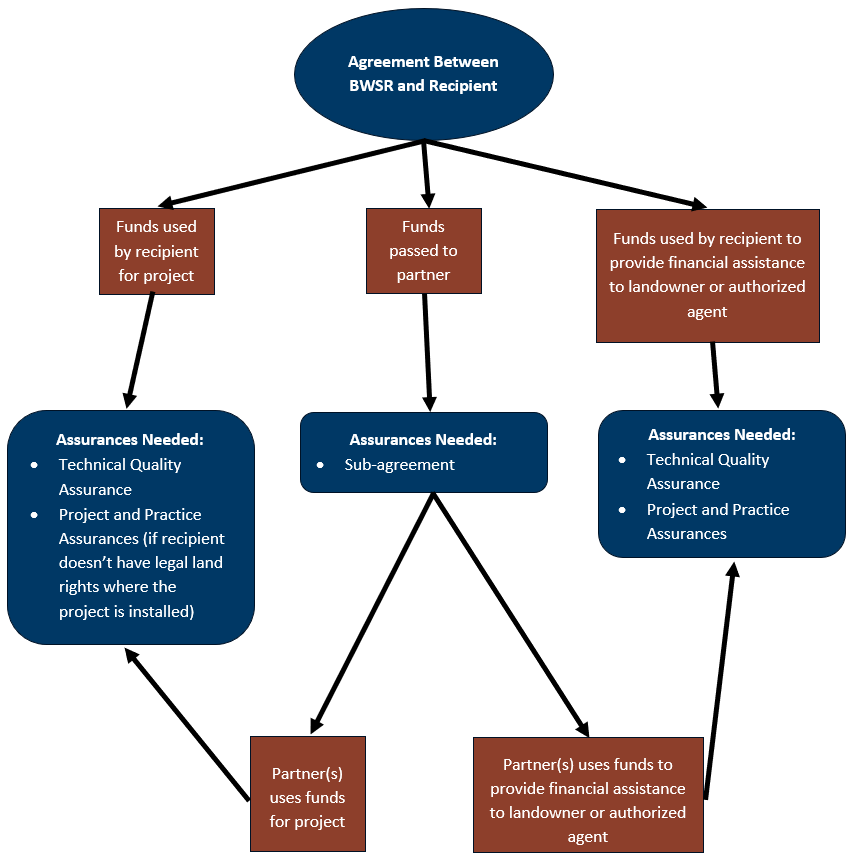
The diagram below outlines assurances needed in different scenarios. The assurances required of primary recipients are also required of partners.
History
Description of revisions | Date |
|---|---|
New Assurances chapter combines elements from Project and Practice Assurances, Technical Quality Assurance, and Operation, Maintenance, and Inspection of Practices chapters of the previous Grants Administration Manual. Updates to the development of the practice operation and maintenance(O&M) plan to require that a Technical Assistance Provider(s) prepare the O&M plan. Updated to reflect new chapter formatting. | 7/1/2025 |
| Operation and Maintenance and Period Practice/Project Inspections procedures updated under the Technical Quality Assurances section. Additional guidance added for Operation and Maintenance Plans. | 7/1/2026 |